Thursday, September 26, 2013

Week Nine - Globalisation and Hollywood

Image Source: Huffington Post
 
When we think of the Western film industry and then think of the Asian film industry, they appear to be worlds apart. But in reality, the two film industries are closer than they have ever been before. It is now more common and acceptable for both Western films and Asian films to incorporate themes and cultures from the other.
The relationship that is being formed between the Hollywood and Asian film industries epitomises the effects of globalisation and ultimately the creation of a world that is more connected than ever before.
 
Image Source: HitFix
Thompson (cited in Rantanen, 2005, p. 7) defines globalisation as the growing interconnectedness of different parts of the world, a process which gives rise to complex forms of interaction and interdependency.
Globalisation has enabled the transnational relationship between the Hollywood film industry and the Asian film industry to thrive in a way that has never been done before. While Western cultures have an enormous influence over film audiences, Asian themes are now becoming more prominent in Western films.
Today we are seeing a partial erosion of the boundaries that once separated Hollywood from local Asian film industries, and a consequent intertwining of industries on both sides of the Pacific (Klein 2004, pg. 361).
The relationship between the two powerhouse film industries continues to grow enabling a greater cultural flow of knowledge, information and technology. Essentially, the films that are collaborations of both cultures provide a stronger connection for the film industry. While these themes and characteristics may not be extremely noticeable, there is no doubt that there is both Western and Asian influence in many blockbusters.
In more recent times, the most noticeable Asian theme that is recurring in many films is martial arts. Klein (2004, pg. 361) points out that martial arts fight scenes have become a ubiquitous feature in action films across the genre map, from science fiction (The Matrix, 1999) to vampire (Blade II, 2002) to superhero (Daredevil, 2003) to video game (Lara Croft: Tomb Raider, 2001) to girl’s empowerment (Charlie’s Angels, 2000) to costume drama (The Last Samurai, 2003).
 
Image Source: geeky-guide
Reference List:
Klein, C 2004, 'Martial arts and globalisation of US and Asian film industries', Comparative America Studies, vol. 2, no. 3, pp. 360-384.
Rantanen, T 2005, 'Theorizing media and globalization', Media and Globalization 2005, Sage Publications, London, pp. 1-18.
Images:


Friday, September 20, 2013

Week 8 - Celebrity, Persona and the Specular Economy

“We are constantly placing ourselves as with the simple technology of the mirror, into the picture and onto the screen. Through this activity of making ourselves mediatized there is a frisson of fame where the self in its reconstruction as a image enters into what we have grown to imagine as a mediascape that constructs notoriety.”
(Marshall, 2010, pg. 499)
The rise of globalisation has brought about change in many different forms. This week our focus is on how the changing online environment has affected the way we view others and ultimately the way we view ourselves. But in today’s society, we are to ask ourselves what makes a person celebrated? Are we all celebrities?
Marshall (2010, pg 499) defines “specular economy” where collectively we are becoming more conscious of how we present ourselves and how others perceive us and this change is migrating to the epicentre of our knowledge economy.

Image Source: MemeBurn
Social media has changed the way we view ourselves online, and it is no different for celebrities. Through globalisation and social media, we are able to construct an alternate persona.
Giddens (cited in Rantanen 2005, pg. 6) identifies globalisation as the intensification of world-wide social relations, which link distant localities in such a way that local happenings are shaped by events occurring many miles away and vice versa.
Celebrities are now, more than ever, able to connect on another level with fans through social media sites such as Twitter, Instagram and Keek. We now have an incredibly complex presentation of the self through the screens of social media via the Internet and mobile communication (Marshall, 2010, pg. 499).
Image Source: EntertainmentDelights
Celebrities can manipulate their public image by posting pictures or videos of themselves in the best light possible. The unrealistic world that they create through each medium is then broadcasted around the world for anyone to see, including impressionable children and teenagers who idolise these celebrities.
Image Source: FamousYahooNZ
Fans are able to see what their favourite celebrity is up to day or night, through one or a combination of social media sites. But, the lines between what should be shared publicly and what should be kept privately are becoming increasingly blurred. Countless celebrities have posted uncompromising images or videos of themselves online, but is it all just for publicity?
In our contemporary online screen culture, the intimacy moves outward into a new quasi-public presentation of the self and a version of ourselves that is mediated through various displays of text and image and sometimes sound that are distributed through friendship networks and beyond (Marshall, 2010, pg. 499).
Reference List
Marshal, P.D 2010, ‘The Specular Economy’, Society, vol. 47, no. 6, pp. 498-502
Rantanen, T 2005, ‘Theorizing media and globalization’, Media and globalization 2005, Sage Publications, London, pp. 1-18
Images:
 

Friday, September 13, 2013

Week Seven - Games and the Global Cultures of Production

The concept of social media and blogging has been associated with the participatory media culture of computer games for many years. While they appear to be worlds apart, they are very similar in many ways. Most games today allow users to communicate through message boards while they play in an effort to enhance the gaming experience. The aspects that social media sites/blogs share with participatory games are virtuality, interactivity and connectivity.  

Social media sites such as Facebook, Twitter and Instagram allow users to create a virtual reality in which they can construct an alternative reality.  Raessens (2005, pg. 374) explains that games offer the possibility to simulate virtual worlds a gamer can explore.
 
Image Source: Second Life

Users of social media become the creator of their own identity as they can choose what they reveal and what they keep hidden from the world. The internet and computer games allow infinite opportunities for people to construct their desired identity.

Chalkley et al (2012, pg. 154) explains that “online worlds” are not only of the avatar-driven Second Life variety, where people assume characteristics that are not (necessarily) their own, and direct ramifications in the ‘real world’ are not so obvious.
Image Source: GameInformer
 
Modern gamers are now able to engage with other gamers from all over the world in Massively Multiplayer Online Role-Playing Games (MMORPGs) to work together to achieve the same goal. A game computer should after all not just be seen as technology that can simulate multimedial virtual worlds one can interact with; it is also increasingly being connected to other computers over the Internet (Raessens, 2005, pg. 374).

This is similar to blogging in that blogs are connected through the blogosphere by similar interests or views, bloggers can form a public sphere where other bloggers who share the same interests are able to join and communicate.

The interactivity aspect of gaming is very similar to that of social media. Both gamers and social media users/bloggers are increasingly interactive as they connect with people from different parts of the world to enhance either their gaming experience or their social connections.

Raessens (2005, pg. 374) explains that in contrast with a “passive” film audience, an interactive game player is enabled, for example, to take up the role of narrator and influence the course of events and actions, possibly as a character in the plot.


References:
Chalkley, T, Brown, A, Cinque, T, Warren, B, Hobbs, M & Finn M 2012, Communication, New Media and Everyday Life, Oxford University Press, Melbourne, Vic.

Raessens, J 2005, ‘Computer games as participatory media culture’, Handbook of computer game studies 2005, MIT Press, Cambridge, Mass, pp. 373-388

Images:

Image 2)  http://www.gameinformer.com/games/diablo_iii/m/diablo_iii_media/2975798.aspx


Thursday, September 12, 2013

Week Six - Blogging and the Blogosphere

Community and Culture in the Blogosphere

Community and culture contribute immensely to the blogosphere, as more and more people connect. Blogs are fast becoming an incredibly popular social media platform with more people signing up each day to be the owner of their own blog. The size of the blogosphere means that people are broadcasting their views to more people than ever before. Having said that, with the enormous amount of blog traffic, people have become prosumers, they choose what media they observe and also what they ignore.

Image Source: TheSituationist

The blogging community is referred to as the blogosphere and is made up of millions of different discussions and conversations, also known as public spheres. The public spheres enable people to connect through similar interests such as community and culture.

Bloggers from all over the world are able to connect with other people who share their beliefs, their cultures and their traditions. Culture, as a part of blogging is very important in that more people can become aware and can appreciate different cultures to their own. Cultural blogs also offer support and education to fellow bloggers who may or may not be a part of that culture. Globalisation has allowed the flow of cultural information to be effective in educating others as well as connecting people all over the world.
Image Source: LifeScoop
Giddens (cited in Rantanen, 2005, pg. 6), defined globalization as the intensification of world-wide social relations, which link distant localities in such a way that local happenings are shaped by events occurring many miles away and vice versa (1990; 64).
The flows of globalization have enabled people to share their culture with people all over the world.
Blogs have been increasingly prominent in the Indonesian cyberspace in recent years and have been successful in promoting a range of subcultures. The medium appears flexible enough to capture the attention of people from various walks of life, from rock music fans to religious groups. Blogs have become a vehicle to produce a new communication sphere: to broadcast personal social and political commentaries, to build networks of individuals of similar interests (e.g., sharing recipes among housewives), to serve as an outlet for personal catharsis (curhat), and even to do the dakwah, as propagated by ustad Ahmad Sarwat
(Lim, 2012, pg. 128)

Reference List:
Lim, M 2012, ‘Life Is Local in the Imagined Global Community: Islam and Politics in the Indonesian Blogosphere’, Journal of Media and Religion, 11:3, 127-140
Rantanen, T 2005, ‘Theorizing media and globalization’, Media and globalization 2005, Sage Publications, London, pp. 1-18

Images:

1) http://thesituationist.wordpress.com/2007/12/02/situationism-in-the-blogosphere/
2) http://mylifescoop.com/2011/08/03/top-10-most-influential-culture-blogs/2/ 


Thursday, August 29, 2013

Week Five - Identity and Uberveillance

Put quite simply, the blogosphere is the culmination of blogs by anyone and about anything. The blogosphere is a place where bloggers can share their ideas to anyone in the world, the size of the blogosphere is unknown, but as the popularity for blogs rise the size of the blogosphere will expand too. People can connect through any topic whether it is music, fashion or politics the list is endless.
 
Image Source: Harvard
 
 
According to Jurgen Habermas (cited in Chalkley et al. 2012, p. 22) ideal speech is the opportunity to hold and voice opinion or to engage in ‘discourse’ whereby all in the public sphere have the ability to raise matters according to the ideal, that what they say is true and honest and that they can confirm their claims.
The public sphere refers to the space where people, in this case bloggers, come together to express shared interests and ideas and to discuss matters that interest them. The blogosphere, in a sense, acts as an independent public sphere as people who have similar interests find other people with who they share their ideas and interests with.
 
The blogosphere can act as an independent and impartial public sphere, having said that, the blogosphere is made up of millions of different topics and subjects. Micro-blogging sites such as Twitter and Instagram allow bloggers to connect through hashtags which enables an instant connection. Initially, the hashtag began on Twitter, but the success of the sharing device that connects you to the same subject has meant that it is now common in most blogs, and even social networking sites such as Facebook.
Image Source: Mashable

Enabling people to connect and communicate on a global scale through blogging has meant that traditional forms of communication are becoming less frequented, as the internet becomes more and more popular.

The increased use of blogging to communicate has created citizen journalism, which has supported and enabled bloggers to spread their news across the world.

Hirst (2011, pg. 17) explains that now that almost everyone can upload their own versions of the ‘news’ to the Internet, the function of journalism is to act as an intelligent sifter of the billions of bytes supplied by amateurs.
 

References:

Chalkley, T, Brown, A, Cinque, T, Warren, B, Hobbs, M & Finn M 2012, Communication, New Media and Everyday Life, Oxford University Press, Melbourne, Vic.

Hirst, M. 2011, ‘News 2.0: Can Journalism Survive the Internet”, Allen and Unwin, NSW, Australia.


Tuesday, August 27, 2013

Week Four - Regulation and Ownership

Is originality a thing of the past?

Distinguishing a clear difference between whether a remixer is an innovator and a pirate has become increasingly challenging. The list of people who could come under the name of a “remixer” is long and ever changing. Remixing products such as music, movies, television shows, fashion, art and design has risen to popularity in the last decade, with the help of globalisation.

Martin, Moore and Salter (2010)  outline the tactics often employed by the music industry in an attempt to curb file-sharing, copying and remixing in ‘Sharing music files: tactics of a challenge to the industry’. These tactics relate mostly to music but can also be applied to other methods of remixing.

The industry claims copyright violation reduces sales of CDs, thereby harming artists, who receive fewer royalties. Lower sales also reduce the industry’s ability to support new artists. File–sharing, according to the industry, is unfair to recorded artists, because they have intellectual property rights in proprietary recordings. The artists and industry put work into producing the recordings, and it is unfair that others can obtain free access (Martin, Moore and Salter, 2010).

The terms mashup artist, DJ, pastiche and bricolage all refer to the combining on two or more separate products, most commonly used in reference to music, to make something “new”. In a sense, the songs or movies that have been produced through either mashup, pastiche or bricolage are original but the content that has been used is someone else’s work.


Image Source: Digital DJ Tips

Mashup artists and DJs have become more and more popular over the last decade, often making their names known all over the world by climbing the charts with successful combinations of songs that already existed.


Image Source: Forbes

The rise of globalisation has enabled goods and services to be shared all over the world in a matter of seconds, meaning that more people have access to more products and are now more than ever before, remixing music, movies, television shows, fashion, art, software and design.
 
The music industry has used devaluation extensively by labelling file–sharers as thieves, pirates and criminals (Martin, Moore, and Salter, 2010).

To say that all remixers are thieves could be perceived as harsh, but the fact is that they are taking something that already exists and making it their own. These creations can be seen as innovative and original in terms of having never been put together before, but the content has been heard before.
References
Martin, B, Moore, C and Salter, C. 2010, ‘Sharing music files: tactics of a challenge to the industry’, First Monday, vol. 15, no. 12, retrieved 23 August 2013, http://firstmonday.org/ojs/index.php/fm/article/view/2986/2680

Wednesday, August 21, 2013

Week Three - Global Economies

Graffiti

 
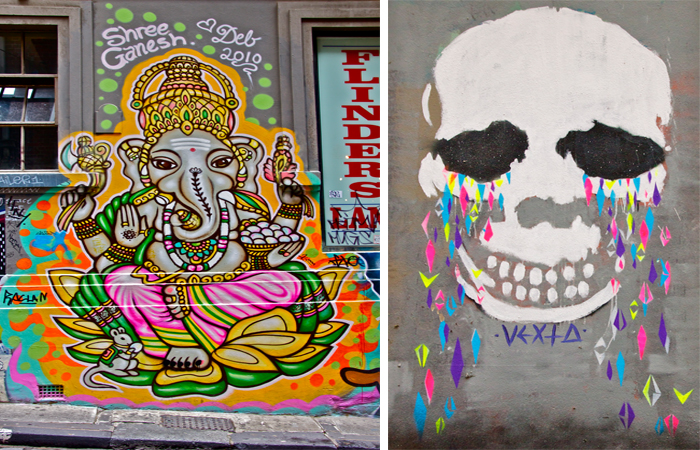
Graffiti is a very fascinating and ever changing art form that lives in every city, all over the world. The graffiti culture has been around for many centuries and has lasted until today, evolving through globalisation.


Graffiti artists use their talents to depict or comment on issues whether they are societal or political, often with hidden messages. The use of graffiti by artists to comment on government issues, politics, war, social changes as well as territorial marks invites the general public to see something in another light. Graffiti artists embed connotative messages into their images.


Image Source: Urban Adventures
 
The flows of globalisation has allowed graffiti to be shared all over the world, the movement of graffiti has been possible through cultural flows as people move around the world sharing their skills, traditions, beliefs and art. Globalisation has allowed graffiti to spill onto the streets, signs, doors and public transport all over the world, connecting artists and their artworks.
 
Thompson’s (cited in Rantanen 2005, p. 7) definition of globalization allows a greater understanding of how the world has become more and more connected in the last decade.
 
“Globalization … refers to the growing interconnectedness of different parts of the world, a process which gives rise to complex forms of interaction and interdependency” (Thompson, 1995: 149).
Banksy, a successful and also very controversial graffiti artist has allowed the world to view his opinion through his graffiti. His graffiti or stencilled street art is popular all over the world for its provocative nature and also the fact that most of them are in positioned in popular public places.


Image Source: Street Art London  

The anonymity of Banksy is one of the biggest aspects about the artist that has made him so popular. People all over the world have heard of Banksy and have seen pictures of his art or have seen it personally, but the interesting thing about Banksy is that most people have no idea who he really is.


References
Rantanen, T 2005, ‘Theorizing media and globalization’, Media and globalization 2005, Sage Publications, London, pp. 1-18