Thursday, August 29, 2013

Week Five - Identity and Uberveillance

Put quite simply, the blogosphere is the culmination of blogs by anyone and about anything. The blogosphere is a place where bloggers can share their ideas to anyone in the world, the size of the blogosphere is unknown, but as the popularity for blogs rise the size of the blogosphere will expand too. People can connect through any topic whether it is music, fashion or politics the list is endless.
 
Image Source: Harvard
 
 
According to Jurgen Habermas (cited in Chalkley et al. 2012, p. 22) ideal speech is the opportunity to hold and voice opinion or to engage in ‘discourse’ whereby all in the public sphere have the ability to raise matters according to the ideal, that what they say is true and honest and that they can confirm their claims.
The public sphere refers to the space where people, in this case bloggers, come together to express shared interests and ideas and to discuss matters that interest them. The blogosphere, in a sense, acts as an independent public sphere as people who have similar interests find other people with who they share their ideas and interests with.
 
The blogosphere can act as an independent and impartial public sphere, having said that, the blogosphere is made up of millions of different topics and subjects. Micro-blogging sites such as Twitter and Instagram allow bloggers to connect through hashtags which enables an instant connection. Initially, the hashtag began on Twitter, but the success of the sharing device that connects you to the same subject has meant that it is now common in most blogs, and even social networking sites such as Facebook.
Image Source: Mashable

Enabling people to connect and communicate on a global scale through blogging has meant that traditional forms of communication are becoming less frequented, as the internet becomes more and more popular.

The increased use of blogging to communicate has created citizen journalism, which has supported and enabled bloggers to spread their news across the world.

Hirst (2011, pg. 17) explains that now that almost everyone can upload their own versions of the ‘news’ to the Internet, the function of journalism is to act as an intelligent sifter of the billions of bytes supplied by amateurs.
 

References:

Chalkley, T, Brown, A, Cinque, T, Warren, B, Hobbs, M & Finn M 2012, Communication, New Media and Everyday Life, Oxford University Press, Melbourne, Vic.

Hirst, M. 2011, ‘News 2.0: Can Journalism Survive the Internet”, Allen and Unwin, NSW, Australia.


Tuesday, August 27, 2013

Week Four - Regulation and Ownership

Is originality a thing of the past?

Distinguishing a clear difference between whether a remixer is an innovator and a pirate has become increasingly challenging. The list of people who could come under the name of a “remixer” is long and ever changing. Remixing products such as music, movies, television shows, fashion, art and design has risen to popularity in the last decade, with the help of globalisation.

Martin, Moore and Salter (2010)  outline the tactics often employed by the music industry in an attempt to curb file-sharing, copying and remixing in ‘Sharing music files: tactics of a challenge to the industry’. These tactics relate mostly to music but can also be applied to other methods of remixing.

The industry claims copyright violation reduces sales of CDs, thereby harming artists, who receive fewer royalties. Lower sales also reduce the industry’s ability to support new artists. File–sharing, according to the industry, is unfair to recorded artists, because they have intellectual property rights in proprietary recordings. The artists and industry put work into producing the recordings, and it is unfair that others can obtain free access (Martin, Moore and Salter, 2010).

The terms mashup artist, DJ, pastiche and bricolage all refer to the combining on two or more separate products, most commonly used in reference to music, to make something “new”. In a sense, the songs or movies that have been produced through either mashup, pastiche or bricolage are original but the content that has been used is someone else’s work.


Image Source: Digital DJ Tips

Mashup artists and DJs have become more and more popular over the last decade, often making their names known all over the world by climbing the charts with successful combinations of songs that already existed.


Image Source: Forbes

The rise of globalisation has enabled goods and services to be shared all over the world in a matter of seconds, meaning that more people have access to more products and are now more than ever before, remixing music, movies, television shows, fashion, art, software and design.
 
The music industry has used devaluation extensively by labelling file–sharers as thieves, pirates and criminals (Martin, Moore, and Salter, 2010).

To say that all remixers are thieves could be perceived as harsh, but the fact is that they are taking something that already exists and making it their own. These creations can be seen as innovative and original in terms of having never been put together before, but the content has been heard before.
References
Martin, B, Moore, C and Salter, C. 2010, ‘Sharing music files: tactics of a challenge to the industry’, First Monday, vol. 15, no. 12, retrieved 23 August 2013, http://firstmonday.org/ojs/index.php/fm/article/view/2986/2680

Wednesday, August 21, 2013

Week Three - Global Economies

Graffiti

 
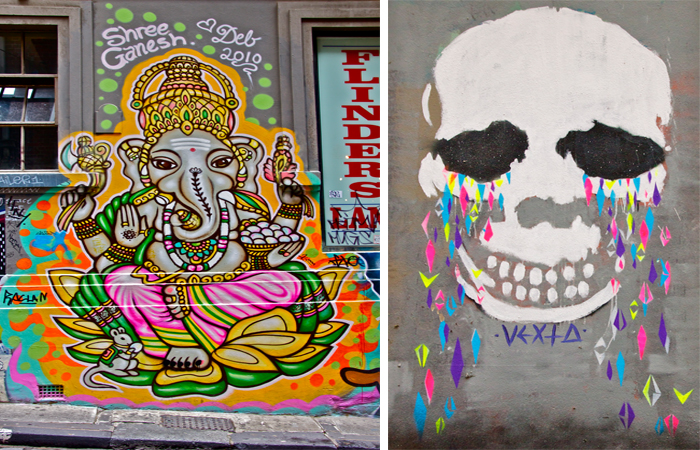
Graffiti is a very fascinating and ever changing art form that lives in every city, all over the world. The graffiti culture has been around for many centuries and has lasted until today, evolving through globalisation.


Graffiti artists use their talents to depict or comment on issues whether they are societal or political, often with hidden messages. The use of graffiti by artists to comment on government issues, politics, war, social changes as well as territorial marks invites the general public to see something in another light. Graffiti artists embed connotative messages into their images.


Image Source: Urban Adventures
 
The flows of globalisation has allowed graffiti to be shared all over the world, the movement of graffiti has been possible through cultural flows as people move around the world sharing their skills, traditions, beliefs and art. Globalisation has allowed graffiti to spill onto the streets, signs, doors and public transport all over the world, connecting artists and their artworks.
 
Thompson’s (cited in Rantanen 2005, p. 7) definition of globalization allows a greater understanding of how the world has become more and more connected in the last decade.
 
“Globalization … refers to the growing interconnectedness of different parts of the world, a process which gives rise to complex forms of interaction and interdependency” (Thompson, 1995: 149).
Banksy, a successful and also very controversial graffiti artist has allowed the world to view his opinion through his graffiti. His graffiti or stencilled street art is popular all over the world for its provocative nature and also the fact that most of them are in positioned in popular public places.


Image Source: Street Art London  

The anonymity of Banksy is one of the biggest aspects about the artist that has made him so popular. People all over the world have heard of Banksy and have seen pictures of his art or have seen it personally, but the interesting thing about Banksy is that most people have no idea who he really is.


References
Rantanen, T 2005, ‘Theorizing media and globalization’, Media and globalization 2005, Sage Publications, London, pp. 1-18
 

Wednesday, July 31, 2013

Week Two - Global Flows and Scapes

There are many different interpretations of what globalisation means, my interpretation of the term is an evolution of a global community that is connected in more ways than ever before. The idea of globalisation is in no way new, its history spans for decades, but the rapid increase of new technologies has meant the global community is shifting and connecting faster than ever before.

A definition of globalisation that I found most interesting in this week’s reading came from Albrow. He defined globalisation as:

“Globalization refers to all those processes by which the people of the world are incorporated into a single world society, global society” (Rantanen, 2005).

The idea of a global society seems truer today than ever before, as more and more people connect on various platforms, enabling a global society to be formed. The formation of this global society has been helped with the increased movement of people, cultures, traditions, food, fashion and trade. The advanced technologies that have become common place all over the world have also had a massive impact on connecting the world.

Another way of looking at the formation of a global community is the various “scapes” of globalisation, introduced by Appadurai in this week’s reading. Appadurai explains that globalization consists of the junctures and disjunctures of five scapes: ethnoscape, mediascape, technoscape, financescape and ideoscape (Appadurai, 1998: 33-6 in Rantanen, 2005, pg. 13). The “scapes” of globalisation overlap as well as interconnect with each other, indicating that each “scape” has helped shape the world we live in today. Two “scapes” that rely heavily on each other are technoscape and mediascape.

Technoscape refers to both mechanical and informational technology that moves at high speeds across various kinds of previously impervious boundaries (Rantanen, 2005, pg. 13). While on the other hand, mediascape refers to the ability and availability of electronic devices to share information instantly. The use of smart devices such as mobile phones, laptops and tablets has increased; therefore the technology of these devices has needed to develop, enabling the consumer to have the very latest and greatest in technology.
 
The more we rely on the internet and our smart devices that offer us everything at the touch of a button, how is our life away from our iPhones, laptops, tablets etc. being affected? Is the next generation going to be able to communicate without a screen in front of them?

References:

Rantanen, T 2005, ‘Theorizing media and globalization’, Media and globalization 2005, Sage Publications, London, pp. 1-18

Tuesday, July 23, 2013

Hello!! And welcome to my blog for ALC215, my name is Emily and for the next few months I will be posting what I think about Globalisation and the Media.

I am a second year Media and Communications student at Deakin University who is very interested in journalism and the inner workings of the media. So far, I have thoroughly enjoyed the course and hope that feeling continues.

This blog will be where I will express my views on the ever changing world that we live in and also where I will respond to various topics covered within this unit.

Thanks for visiting!

Emily :)